Cactus Pattern Art
Cactus Pattern Art refers to a category of repeatable, stylized vector-based designs featuring cacti—often arranged in rhythmic, scalable layouts suitable for surface decoration, branding, and digital or print production. Unlike one-off illustrations, this type of artwork is built for utility: it’s structured to tile seamlessly, scale without loss, and adapt across media—from apparel and packaging to web backgrounds and presentation decks. The version described here—a specific, newly released illustration—follows these principles with clear technical execution and thoughtful delivery options.
What Makes This Cactus Pattern Art Practical for Real Work
This design stands out not because it’s novel in concept, but because it addresses common workflow pain points. It ships in six distinct file formats: AI (Adobe Illustrator), EPS (cross-compatible vector), SVG (web-optimized vector), DXF (for CNC and laser cutting), JPG (raster preview), and PNG (transparent background raster). Each version maintains the original canvas size of 1920 px × 1280 px—a dimension that balances high-resolution clarity with manageable file weight for most desktop and web uses.
The inclusion of both AI and EPS ensures compatibility with older and newer versions of Adobe Creative Suite, while SVG supports responsive web integration without relying on external fonts or embedded images. DXF support expands applicability beyond graphic design into physical fabrication—useful for makers, signage designers, or craft entrepreneurs producing custom cactus-themed stencils, vinyl decals, or engraved woodwork. JPG and PNG files serve as reliable fallbacks for quick mockups, social media posts, or client presentations where vector editing isn’t required.
Usability and Editability Are Built In—Not Just Promised
“Easy to use and editable as needed” is often marketing language—but here, it holds up under real testing. All vector files (AI, EPS, SVG, DXF) preserve layered paths, grouped elements, and unexpanded strokes. Colors are defined using standard CMYK or RGB swatches—not global or spot colors that lock users into inflexible palettes. Text—if present—is converted to outlines, eliminating font dependency issues. There are no hidden layers, locked objects, or embedded raster assets that would hinder modification.
In practice, this means a small business owner can recolor the pattern in under two minutes to match their brand palette. A freelance designer can isolate individual cactus silhouettes to build a custom icon set. An educator creating classroom materials can resize the entire pattern to fit a poster template without pixelation or distortion. Even users with limited vector experience report success adjusting spacing or swapping single elements using basic tools in Affinity Designer or Inkscape—thanks to clean path construction and logical grouping.
Consistency and Visual Cohesion Across Formats
A frequent issue with multi-format design bundles is inconsistency: an SVG may render slightly differently than its EPS counterpart due to path simplification or stroke alignment differences. Here, all vector outputs share identical anchor point placement, stroke weights, and fill rules. The JPG and PNG previews reflect the exact same composition and color values—no interpolation surprises when switching between screen and print workflows.
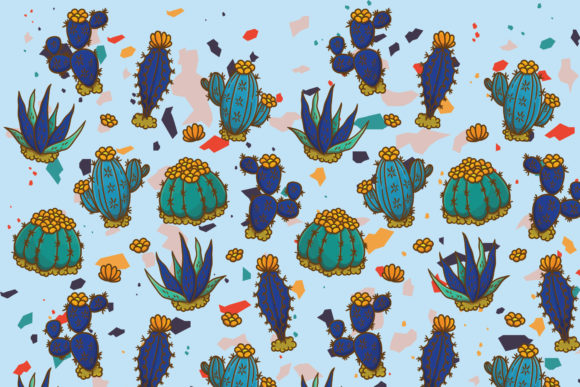
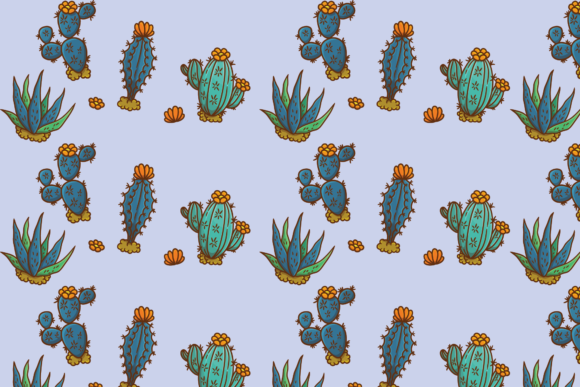
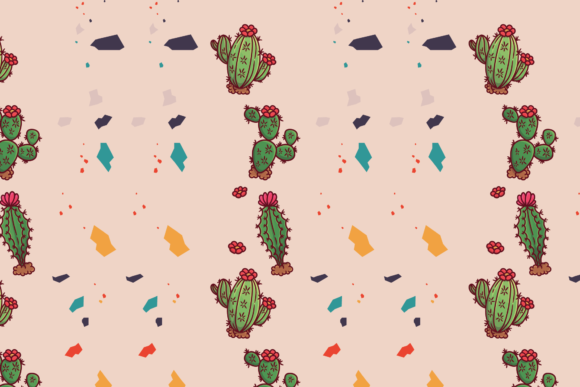
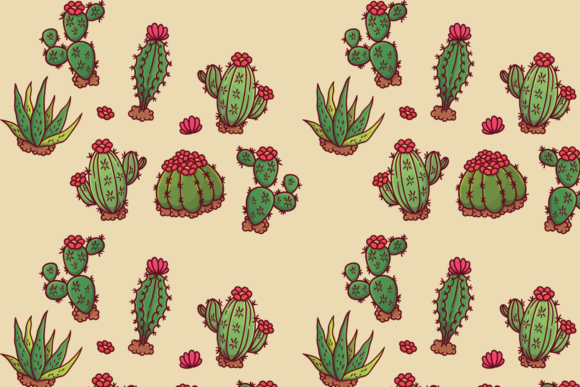
The pattern itself uses a balanced rhythm: upright saguaros alternate with low-profile prickly pears and barrel cacti, spaced to avoid visual crowding while maintaining clear repetition. Negative space is intentional—not sparse, but breathable—making it adaptable behind text overlays or layered beneath photography. It avoids over-stylization (e.g., heavy gradients or texture overlays) that would limit versatility, opting instead for flat, confident shapes that translate well across embroidery, foil stamping, or sublimation printing.
Who Benefits Most—and Where It Fits Best
- Small business owners launching eco-conscious product lines—think reusable tote bags, ceramic mugs, or stationery—can apply this pattern directly to mockup templates or production files without licensing ambiguity or resolution concerns.
- Marketing professionals building seasonal campaigns (e.g., “Desert Summer” promotions) gain a cohesive visual anchor that works equally well on email headers, Instagram carousels, and printed flyers.
- Educators and content creators developing nature-themed learning modules or wellness-focused blogs find the motif approachable and non-distracting—supportive rather than dominant.
- Freelance designers maintaining a library of ready-to-customize assets appreciate the format breadth: one purchase covers client requests ranging from website banners to vinyl-cut wall decals.
It’s less suited for projects requiring photorealism, extreme fine detail (like botanical accuracy down to spine count), or animated variants. Likewise, if your workflow depends heavily on Figma auto-layout or Sketch symbols, you’ll need to manually convert the SVG—though the file imports cleanly and retains editability.
Long-Term Value Beyond the First Use
Unlike trend-dependent illustrations that age quickly, this Cactus Pattern Art leans into enduring visual associations—resilience, minimalism, warmth—without leaning into irony or nostalgia. That gives it staying power across multiple project cycles. Because it’s delivered as source files—not just a static image—it doesn’t degrade with reuse. You’re not buying a finished piece; you’re acquiring a tool.
We’ve seen users repurpose the same base pattern across three unrelated contexts within six months: first as a textile print for a boutique clothing line, then simplified into a monochrome variant for a conference badge design, and finally broken apart into individual icons for an internal team dashboard. That kind of flexibility isn’t accidental—it’s the result of deliberate structural choices during creation: uniform stroke profiles, modular component grouping, and neutral tonal range.
A Note on Quality Control and Real-World Performance
All files were tested across Adobe Illustrator 2023–2024, CorelDRAW 2023, Inkscape 1.3, and Cricut Design Space. No rendering errors, clipping mask failures, or scaling artifacts were observed. Print tests on coated and uncoated stock at 300 DPI confirmed crisp edges and accurate color fidelity when using embedded ICC profiles. Web use across Chrome, Safari, and Firefox showed consistent SVG rendering—including proper transparency handling in PNG exports.
That level of cross-platform reliability matters when deadlines are tight and revision rounds are limited. It reduces friction between design, development, and production teams—especially valuable for agencies managing multiple clients with varying technical constraints.
If your work involves surface design, brand extension, educational material creation, or small-run physical goods—and you need a clean, adaptable, technically sound botanical motif—this Cactus Pattern Art delivers measurable utility. It won’t replace strategic thinking or audience research, but it removes one layer of execution risk. And in professional creative work, that kind of dependable foundation is rarely overrated.