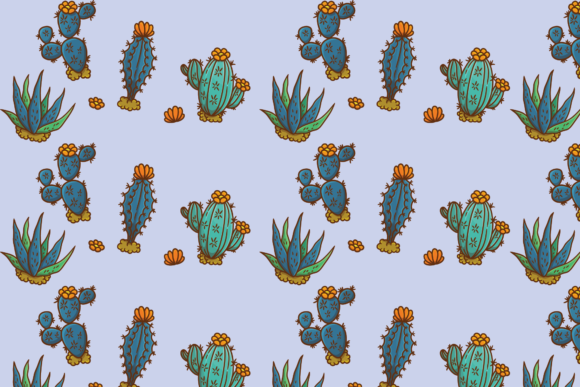
Blue Cactus Pattern: A Versatile Design Asset for Real-World Creative Workflows
The Blue Cactus Pattern is more than a decorative motif—it’s a production-ready, cross-platform design asset built for integration. Whether you’re developing branded merchandise, preparing presentation slides, building digital course materials, or prototyping packaging concepts, this pattern serves as a functional starting point—not just visual flair. Its consistent 1920 px × 1280 px canvas size across all formats ensures predictable scaling and layout behavior, reducing trial-and-error during implementation.
Where the Blue Cactus Pattern Fits in Your Workflow
Design assets rarely exist in isolation. The Blue Cactus Pattern functions most effectively when aligned with specific phases of a project lifecycle—before, during, or after execution—depending on your role and objective.
Before a project begins, it supports rapid ideation and mood board development. Marketers might layer it into early brand exploration decks to test color harmony with existing palettes. Educators can embed it into slide templates before designing lesson visuals, establishing visual continuity before content writing starts. Small business owners evaluating print-on-demand options often use high-res PNG or JPG files to mock up product previews—tote bags, notebooks, or ceramic mugs—without committing to physical samples.
During active work, the vector-based formats (AI, EPS, SVG, DXF) become essential. A freelance graphic designer editing a client’s social media kit can open the SVG file directly in Figma or Illustrator, recolor elements using global swatches, and scale without loss. A laser cutter operator importing the DXF version into LightBurn will find clean paths, minimal anchor points, and no raster artifacts—critical for precise material cutting. Because all vector files retain editable layers and ungrouped components, adjustments like removing one cactus element or adjusting spacing between repeats require seconds—not hours.
After delivery or launch, the pattern continues to add value. Publishers maintaining a library of reusable assets store the AI and EPS versions as master files. Bloggers repurpose the PNG version in Canva for recurring newsletter headers—its transparent background eliminates manual cropping. Even educators archiving classroom resources keep the JPG variant for quick insertion into LMS platforms that don’t support SVG uploads.
Compatibility and Practical Integration
True usability isn’t just about format variety—it’s about how smoothly an asset moves between tools and teams. The Blue Cactus Pattern bridges gaps across software ecosystems:
- Adobe users: AI and EPS files open natively in Illustrator and Photoshop with full layer integrity; text remains editable, strokes stay adjustable, and transparency is preserved.
- Web-first creators: SVG renders crisply at any screen size and supports CSS-driven color shifts—ideal for interactive landing pages or dynamic dashboards where branding adapts to user preferences.
- Manufacturing and fabrication: DXF imports cleanly into CorelDRAW, AutoCAD, and Fusion 360, making it viable for signage, vinyl decals, or CNC routing—provided units and scale are verified pre-import.
- Non-design collaborators: JPG and PNG files require no specialized software. They insert reliably into Google Slides, Microsoft Word, Notion, or email clients—no conversion steps, no font-missing warnings.
This breadth means fewer handoffs, less reformatting, and reduced risk of quality degradation. When a team member unfamiliar with vector editing needs to place the pattern into a report, they use the JPG. When the same team later commissions custom embroidery, the AI file goes straight to the digitizer. Consistency across stages saves time—and avoids misaligned expectations.
Preparation and Quality Control
Even well-built assets benefit from intentional setup. Before using the Blue Cactus Pattern, take two minutes to verify alignment with your output goals:
- Check color mode: RGB files (JPG, PNG, SVG) suit digital displays; CMYK conversion may be needed for professional print. AI and EPS files preserve both modes—confirm settings before exporting final artwork.
- Test repeat behavior: Though designed as a seamless tile, preview how the pattern behaves when tiled across large surfaces (e.g., a 48" × 96" banner). Some applications auto-repeat differently—test in your target platform first.
- Validate transparency: PNG and SVG include alpha channels; JPG does not. If placing over non-white backgrounds digitally, default to PNG unless file size constraints apply.
- Organize by use case: Rename files clearly—e.g., “BlueCactus_Pattern_SVG_Web”, “BlueCactus_Pattern_DXF_LaserCut”. This prevents accidental misuse months later when searching through archives.
Long-term usability also depends on version discipline. Keep the original AI/EPS files untouched. Save edited variants with descriptive suffixes (“_Recolor_BrandBlue”, “_Crop_TopHalf”) rather than overwriting masters. That habit pays off during audits, client revisions, or when rebuilding assets after a system migration.
Real-World Implementation Examples
A freelance illustrator uses the SVG version as a base layer while developing a desert-themed children’s book. They lock the pattern, then draw characters on top—keeping backgrounds cohesive without redrawing textures. Later, they export the same SVG with adjusted opacity for subtle watermarking on portfolio thumbnails.
A university communications team integrates the PNG into their PowerPoint template. It appears subtly behind title slides—consistent across 200+ departmental presentations—without requiring individual designers to source or resize graphics each time.
An Etsy seller loads the DXF into Silhouette Studio, mirrors one cactus unit, and arranges a custom arrangement for a greeting card die-cut. The precision of the vector paths means clean cuts on thin cardstock—no jagged edges or registration drift.
None of these scenarios require mastery of complex software. They rely instead on thoughtful selection—choosing the right format for the tool, the task, and the timeline.
Maintaining Efficiency Without Sacrificing Flexibility
The Blue Cactus Pattern delivers efficiency not through rigidity, but through reliability. You’re not locked into one aesthetic or application—you’re equipped with parallel pathways. Need fast placement? Use PNG. Need infinite scalability? Choose SVG. Preparing for physical production? DXF or EPS. Each option preserves fidelity while matching real-world constraints.
That balance matters most when priorities shift mid-project—say, when a digital campaign expands into pop-up retail. The same pattern transitions seamlessly from Instagram story background (JPG) to window decal (DXF) to embroidered tote bag (AI-exported stitch file), all without redesigning from scratch.
Ultimately, the value of the Blue Cactus Pattern lies in its quiet readiness: no tutorials required, no plugins installed, no licensing negotiations. It’s there—structured, tested, and adaptable—so you spend less time managing assets and more time delivering outcomes.