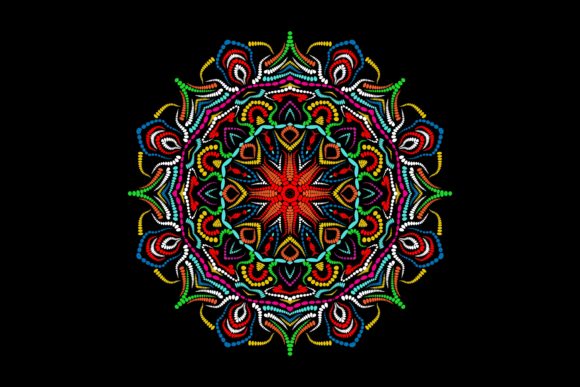
Mandala Pattern Colorful Ornament Flower
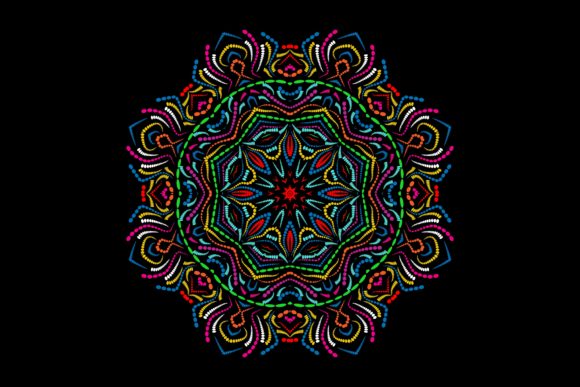
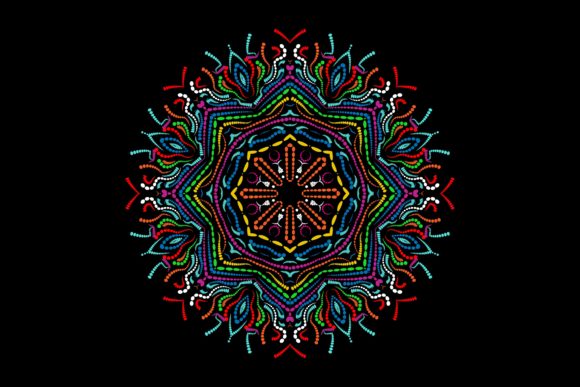
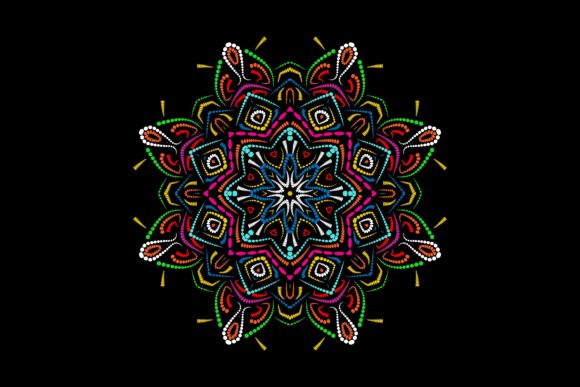
A Mandala Pattern Colorful Ornament Flower is a vector-based decorative design that combines the symmetry and spiritual resonance of traditional mandala forms with floral motifs and vibrant, balanced color palettes. It is not a physical object but a digital asset—typically delivered as a scalable vector file (AI) alongside a high-resolution raster version (JPEG). This dual-format delivery supports both precise cutting applications (e.g., vinyl, paper, fabric) and high-fidelity printing on diverse surfaces.
Unlike generically styled floral borders or isolated clipart, this design integrates radial geometry, layered petal-like elements, and intentional color transitions to evoke harmony and visual rhythm. The “colorful” aspect refers not to randomness, but to thoughtful hue selection—often using complementary or analogous schemes—that maintains clarity at multiple sizes and ensures legibility when printed or cut.
Why People Explore This Design
Individuals commonly seek a Mandala Pattern Colorful Ornament Flower for projects requiring both aesthetic richness and functional versatility. Crafters evaluating design assets often look for patterns that support repeat use across contexts—such as wedding stationery, ceremonial décor, textile embellishment, or body art templates. Educators, therapists, and wellness practitioners may also consider it for mindfulness activities or visual aids, given the mandala’s historical association with focus and balance.
Search behavior reflects practical intent: users frequently pair terms like “vector mandala flower,” “printable ornament,” or “cut file for Cricut” with descriptors such as “colorful” or “ornamental.” This signals an emphasis on usability—not just appearance—but also compatibility with tools like Adobe Illustrator, Silhouette Studio, or Cricut Design Space.
Key Benefits and Realistic Expectations
The primary benefit lies in scalability and format flexibility. Because the AI file is vector-based, the Mandala Pattern Colorful Ornament Flower retains crisp edges whether scaled to 2 inches for a greeting card or 24 inches for a wall hanging. The included JPEG offers immediate use for web display, presentations, or quick mockups without specialized software.
Color fidelity is another advantage—if the file uses CMYK or RGB profiles appropriate for its intended output (e.g., print vs. screen), colors reproduce consistently across devices and printers. However, users should verify embedded color profiles and test prints before large-scale production, especially when matching brand palettes or Pantone references.
It is important to note that this is a static design—not customizable by default. While vector files allow manual editing (e.g., recoloring paths, adjusting stroke weights), no built-in sliders or layers for automatic variation are included unless explicitly stated by the source. Users expecting plug-and-play personalization (e.g., changing flower count or swapping motifs on demand) will need design software proficiency or external customization services.
Situations Where This Design Fits Well
A Mandala Pattern Colorful Ornament Flower is a strong fit when:
- Consistency across media matters: A wedding planner sourcing décor for invitations, table numbers, and fabric backdrops benefits from one cohesive motif rendered identically across substrates.
- Cutting precision is required: Crafters using die-cutting machines or laser cutters rely on clean vector paths; this design’s closed shapes and minimal overlapping elements reduce post-processing cleanup.
- Time efficiency is a priority: Compared to building a mandala from scratch in Illustrator, a ready-made file accelerates prototyping—especially for those with intermediate design skills but limited bandwidth for complex illustration.
- Henna or stencil work is planned: Its radial layout and clear negative space support transfer onto skin or fabric, provided sizing and line weight suit the application method (e.g., thicker strokes for hand-drawn stencils).
When Alternatives May Be More Appropriate
This design may be less suitable in several scenarios. For example, if a project requires strict monochrome output (e.g., black-and-white embroidery or engraving), a multicolored file adds unnecessary complexity—users would need to manually convert and adjust contrast, potentially losing detail in fine areas.
Likewise, highly specific cultural or religious contexts warrant caution. While mandalas appear across many traditions, their symbolic meaning varies significantly between Hindu, Buddhist, Indigenous, and contemporary secular uses. A generic ornamental version may lack the ritual accuracy needed for ceremonial objects or educational materials where authenticity is essential.
For large-scale commercial branding—such as packaging or apparel lines—licensing terms become critical. Not all vector files include extended commercial rights. Users intending resale or mass production must confirm usage permissions, especially regarding derivative works or attribution requirements.
Practical Decision-Making Considerations
Before selecting a Mandala Pattern Colorful Ornament Flower, evaluate three factors: purpose, technical capacity, and scalability needs.
First, clarify the end use. Is the goal decoration only—or does the design need to function as a template (e.g., for lace cutting), a base layer (e.g., under watercolor painting), or a structural element (e.g., aligning with seam allowances in sewing)? Each use case places different demands on line weight, spacing, and file structure.
Second, assess your software access and comfort level. AI files require vector-editing tools. If you primarily use Canva or free online editors, the JPEG may suffice for basic printing—but limits manipulation. Confirm whether your workflow supports opening, ungrouping, and editing vector layers before purchase.
Third, consider how the design scales in practice. Zoom into sample previews: do thin lines remain visible at small sizes? Do color boundaries stay distinct when reduced? Test prints at 25%, 50%, and 100% scale to observe rendering behavior—especially if applying to textured surfaces like burlap or kraft paper, where detail can blur.
Finally, compare metadata. Reputable sources often provide file specs: dimensions, DPI, color mode, layer organization, and path simplification level. These details signal whether the file was prepared for professional output or general-purpose use—and help avoid surprises during production.
In summary, the Mandala Pattern Colorful Ornament Flower serves best as a versatile, production-ready foundation—not a final solution. Its value emerges most clearly when matched thoughtfully to both technical constraints and expressive goals. Evaluating it through the lens of integration (with tools, materials, and intent) rather than aesthetics alone leads to more confident, effective use.