Colorful Leaves Seamless Pattern: A Versatile Vector Resource for Design and Production
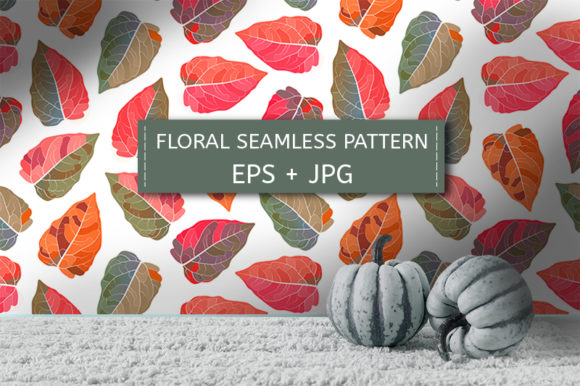
Seamless patterns built from organic, vibrant botanical elements continue to shape visual language across industries—from high-end fashion houses to independent stationery brands and interior design studios. Among the most adaptable of these resources is the Colorful Leaves Seamless Pattern: a meticulously crafted vector composition featuring stylized foliage in varied hues, arranged with mathematical precision to tile infinitely without visible seams. Unlike raster-based repeats or hand-drawn motifs that degrade at scale, this pattern leverages vector geometry to maintain fidelity at any dimension—making it equally effective on a postage stamp or a 20-foot wallpaper mural.
What Makes This Pattern Technically Distinct?
The foundational strength of the Colorful Leaves Seamless Pattern lies in its dual-format delivery and intentional technical architecture. The package includes one EPS 10 file—fully editable in Adobe Illustrator—with layered paths, grouped elements, and non-destructive color swatches. Every leaf, stem, and negative space is constructed using Bézier curves rather than embedded bitmaps, allowing designers to adjust stroke weights, recolor individual components, or isolate specific botanical forms without loss of quality.
Equally important is the included high-resolution JPG (5000×4000 px), pre-rendered at 300 DPI and optimized for immediate use in Photoshop-based workflows. This hybrid approach bridges vector flexibility with pixel-perfect predictability—particularly valuable when integrating the pattern into layered mockups, textile simulations, or photorealistic interior visualizations. Because the repeat unit is precisely calculated—not approximated—the pattern aligns flawlessly across canvas boundaries in both digital and print environments.
Real-World Applications Across Industries
Designers don’t select patterns in isolation; they evaluate them against functional constraints, production methods, and end-user expectations. The Colorful Leaves Seamless Pattern demonstrates exceptional breadth in deployment:
- Fabric & Textile Design: Used by apparel brands to develop seasonal prints for cotton voile dresses, linen napkins, or upholstery-grade polyester blends. Its balanced density—neither overcrowded nor sparse—ensures clarity during screen printing and digital textile printing, even on textured substrates like bouclé or seersucker.
- Interior Surfaces: Applied as wallpaper in residential and hospitality settings, where the white background enhances light reflection in smaller rooms while the chromatic variation adds depth without visual fatigue. Architects have specified it for acoustic wall panels and custom cabinetry laminates, leveraging its scalability to match modular panel dimensions.
- Packaging & Paper Goods: Adopted by eco-conscious brands for wrapping paper, gift tags, and box liners. The white base reduces ink coverage requirements, lowering material costs and environmental impact—especially relevant for soy- or water-based inks used in sustainable packaging.
- Digital Paper & UI Elements: Integrated into Notion templates, printable planners, and educational worksheets. Educators report improved student engagement when using floral vector seamless pattern backgrounds in science units on botany or seasonal cycles—visual consistency supports cognitive anchoring without distraction.
- Tiling & Surface Mockups: Employed by architects and 3D modelers as texture maps for ceramic, porcelain, and terrazzo surfaces. Its uniform tiling behavior eliminates UV stretching artifacts in Blender, SketchUp, and Revit renderings—a common pain point with poorly constructed repeats.
Why White Background Matters—Beyond Aesthetics
The choice of a pure white background in the Colorful Leaves Seamless Pattern is not merely stylistic—it’s a strategic design decision rooted in production pragmatism. White serves as a neutral foundation that accommodates diverse color systems: designers can overlay Pantone spot colors for brand-aligned fabric runs, apply duotone filters for retro-inspired stationery, or invert values for dark-mode digital interfaces. Unlike off-white or cream bases—which introduce subtle color casts that complicate color matching—the white field preserves chromatic integrity across devices and output methods.
This neutrality also simplifies post-processing. In Photoshop, users can employ blending modes like Multiply or Overlay to integrate the pattern into existing compositions without clipping masks or layer adjustments. For manufacturers, white backgrounds reduce prepress time: no need to manually remove background layers before sending files to rotary screen printers or wide-format inkjet plotters.
Workflow Integration: From Concept to Output
How professionals actually use this resource varies significantly by role—and reveals deeper insights about interoperability. A fashion designer might import the EPS into Illustrator, ungroup the leaf cluster, and reposition three key elements to create a custom focal motif for a scarf repeat. A product manager at a home goods startup may drag the JPG directly into Canva, resize it to fit a Shopify banner, and add semi-transparent text overlays—all within five minutes. Meanwhile, a textile engineer could import the same EPS into Gerber Accumark or Optitex to test drape simulation with realistic pattern distortion.
Crucially, the pattern’s construction avoids nested clipping masks, raster effects, or transparency layers that break compatibility with older RIP (raster image processor) software used in commercial printing facilities. That backward compatibility—often overlooked in creative asset libraries—means fewer revision rounds and faster time-to-market. One industrial designer noted using the same file across three consecutive product launches: first for a limited-edition notebook series, then scaled up for trade show booth graphics, and finally repurposed as embroidery digitizing reference for a capsule apparel line.
Considerations for Ethical and Sustainable Use
As demand grows for responsibly sourced visual assets, the Colorful Leaves Seamless Pattern reflects evolving industry standards. Its vector-native format inherently supports sustainability: no physical storage media, minimal bandwidth consumption during transfer, and zero degradation over repeated use—unlike JPEG-heavy libraries that require constant re-downloading due to compression artifacts. Moreover, because all leaves are stylized abstractions—not photorealistic depictions of endangered species—the pattern avoids unintentional biopiracy concerns sometimes raised around culturally specific or ecologically sensitive botanical imagery.
That said, context remains essential. When applied to medical packaging or children’s products, designers should verify contrast ratios between leaf colors and background for accessibility compliance (e.g., WCAG 2.1 AA). Similarly, cultural associations of certain leaf shapes—such as maple in Canada or olive in Mediterranean contexts—warrant sensitivity in global branding initiatives. The pattern itself is neutral; interpretation emerges through placement, scale, and adjacent typography.
Comparative Strengths in the Pattern Landscape
Not all seamless botanical patterns deliver equal utility. Many rely on scanned watercolor textures or low-resolution PNG tiles that blur when enlarged. Others feature overly complex arrangements—dense clusters of overlapping leaves that lose legibility below 12 inches in width. The Colorful Leaves Seamless Pattern distinguishes itself through deliberate restraint: moderate spacing between elements, consistent stroke hierarchy, and a curated palette of six harmonized hues (teal, saffron, plum, sage, coral, and citrine) that pass accessibility contrast checks against white.
Its advantage over generative AI–produced patterns is equally tangible. While AI tools can produce visually rich variations rapidly, they often fail at true seamlessness—introducing micro-gaps or misaligned nodes at tile boundaries. Human-crafted vector patterns like this one undergo manual node inspection and alignment verification, ensuring reliability across thousands of production cycles. That level of craftsmanship translates directly into reduced waste during fabric cutting, fewer press stops during wallpaper installation, and higher client retention in freelance design engagements.
Long-Term Value Beyond First Use
A hallmark of professionally viable design assets is longevity—the capacity to remain useful across shifting trends and technological upgrades. The Colorful Leaves Seamless Pattern exhibits strong temporal resilience. Its stylization avoids faddish details (e.g., hyper-realistic veins or trendy gradients) that date quickly. Instead, it draws on enduring principles of rhythm, balance, and organic symmetry—qualities observed in historic chintz prints, Art Nouveau borders, and contemporary Scandinavian textiles alike.
Users report returning to the file years after initial purchase—not just for repeat projects, but as a teaching tool. Design instructors use it to demonstrate vector path manipulation, repeat unit mathematics, and color theory applications. Researchers studying visual perception have adapted its structure for controlled experiments on pattern recognition thresholds. Even hobbyists repurpose individual leaf vectors as stencils for woodburning or laser-cut jewelry components—proof that thoughtful vector construction unlocks secondary utility far beyond its original scope.
Final Implementation Insight
When deploying the Colorful Leaves Seamless Pattern, success hinges less on technical execution and more on contextual intention. A tile background for a meditation app benefits from reduced saturation and increased spacing between elements; the same file, used for a children’s book cover, gains impact when scaled to fill the entire spread with bold, unclipped edges. The white background isn’t a limitation—it’s a canvas. And the floral vector seamless pattern isn’t just decoration; it’s infrastructure for visual communication—designed to serve, adapt, and endure.