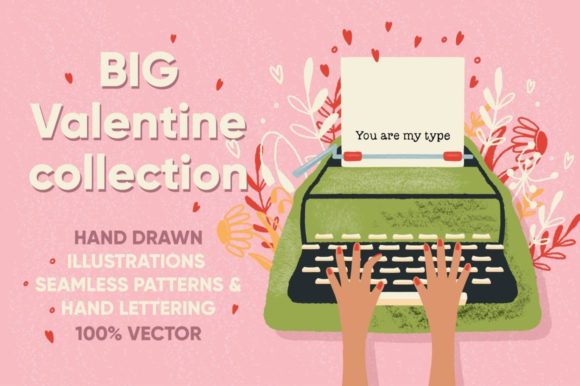
BIG Valentine Collection: A Versatile Design Resource for Creative Professionals and Educators
The BIG Valentine Collection stands apart not as seasonal decoration—but as a rigorously crafted, production-ready design system built for real-world application across disciplines. Comprising 36 original hand-lettered designs, each expanded into seamless patterns and delivered in three industry-standard formats—AI, EPS10, and high-resolution JPG—the collection totals 108 files, all rendered at 5000 × 5000 pixels. This precision ensures scalability without quality loss, whether printed on greeting cards or layered into digital course materials. Unlike generic clipart bundles, the BIG Valentine Collection was developed with intentionality: every motif balances thematic resonance (love, connection, warmth) with functional neutrality—making it equally viable for a university’s inclusive wellness campaign or a boutique stationery brand launching a gender-inclusive gift line.
Why Format Diversity Matters in Practice
Designers often underestimate how format limitations constrain workflow efficiency. The BIG Valentine Collection anticipates this by delivering identical assets in AI (Adobe Illustrator), EPS10 (cross-compatible vector), and JPG (print-optimized raster). Each serves a distinct role:
- AI files allow full editability—adjusting individual letterforms, re-coloring paths, or isolating elements for custom layouts. A graphic designer preparing a series of social media banners can modify stroke weights or invert color schemes without rebuilding from scratch.
- EPS10 files provide backward compatibility with older versions of Illustrator, CorelDRAW, and Affinity Designer. Educators using school-licensed software on aging hardware benefit from reliable import—no missing fonts or corrupted paths.
- JPG files are pre-rendered at 300 DPI and 5000 × 5000 pixels, eliminating rendering delays during print prep. A small-business owner uploading to a print-on-demand platform avoids compression artifacts or resolution warnings that commonly derail time-sensitive orders.
This tri-format approach reduces friction—not just for designers, but for non-design stakeholders. Marketing coordinators, curriculum developers, and event planners can use the JPGs directly in Canva or PowerPoint without installing vector software. Meanwhile, professional studios retain full creative control via editable vectors. The result is interoperability across skill levels and tools—a practical advantage rarely emphasized in design asset marketing but deeply consequential in daily execution.
Hand Lettering That Functions Beyond Aesthetics
Each of the 36 core designs originates from hand-lettered originals—not algorithmically generated scripts or traced fonts. This origin informs both visual character and structural utility. Hand-drawn curves carry subtle asymmetry and organic rhythm, lending warmth to clinical applications like healthcare infographics or academic posters where emotional resonance supports message retention. One design, “Tenderly,” uses staggered baseline alignment and varying x-heights to imply gentle motion—ideal for illustrating concepts like empathy development in teacher training modules.
More critically, the hand-lettered foundation enables seamless tiling without mechanical repetition. Because motifs were drawn with tiling logic embedded—repeating elements offset, mirrored, or rotated to avoid visual fatigue—the resulting patterns feel cohesive rather than cyclical. A textile designer applying one of these patterns to fabric swatches observes no visible “seams” even at large scale; similarly, a web developer using a pattern as a CSS background image sees consistent density across viewports. This isn’t accidental—it reflects deliberate construction informed by decades of pattern-making principles, adapted for contemporary digital workflows.
Real-World Applications Across Sectors
The versatility of the BIG Valentine Collection emerges most clearly when examined through applied use cases—not abstract categories.
Educational Materials Development
Instructional designers building SEL (Social-Emotional Learning) resources frequently struggle with imagery that feels either infantilized or emotionally vague. The collection’s restrained palette and intentional spacing—note how “Together” uses generous letter spacing and soft shadowing—allow educators to convey interdependence without cliché. One university’s counseling center used the “Anchor” pattern as a repeating background in student-facing PDF workbooks, reinforcing stability visually while keeping text fully legible. No licensing hurdles arose because all files are royalty-free for internal and client-facing educational use.
Small Business Brand Extensions
A local bakery specializing in custom confections licensed the “Sweetheart” design to create limited-edition packaging. Rather than using the motif as a standalone logo, they extracted its negative space and converted it into a foil-stamped texture on kraft paper boxes. Because the AI file retained vector integrity at any scale, the texture remained crisp—even on 12-inch square boxes. Simultaneously, they deployed the JPG version as a watermark across Instagram Stories, ensuring brand consistency without slowing down content publishing.
Research Communication and Public Outreach
Public health researchers presenting findings on relationship resilience incorporated the “Rooted” pattern into data visualization slides. Its vertical, branching structure subtly reinforced the concept of foundational support systems—without requiring textual explanation. The high-resolution JPG ensured clarity during projection, while the EPS version allowed direct embedding into LaTeX-generated conference proceedings, preserving typographic fidelity.
Technical Considerations for Long-Term Usability
While aesthetic appeal draws initial interest, long-term value hinges on technical reliability. The BIG Valentine Collection addresses several under-discussed pain points:
- Color model consistency: All vector files use CMYK profiles optimized for offset printing, while JPGs embed sRGB for screen accuracy—avoiding unexpected hue shifts between digital proofing and physical output.
- Font independence: No live typefaces are embedded; all lettering is outlined. This eliminates font substitution errors when opening files across machines or operating systems.
- Layer organization: AI and EPS files group related elements logically (e.g., “shadow,” “main glyph,” “accent stroke”)—enabling quick visibility toggling during layout adjustments.
- Metadata transparency: Each file includes embedded copyright and usage notes, simplifying compliance tracking for institutions managing large asset libraries.
These details matter most when projects evolve. A nonprofit developing an annual report may begin with JPG mockups in Google Slides, then transition to AI files for final print production—all without reworking composition or adjusting color values. That continuity saves hours per project, compounding value across multiple initiatives.
Integrating the Collection Into Existing Workflows
Adoption doesn’t require overhauling established processes. Teams integrate the BIG Valentine Collection incrementally:
- Start with context-specific testing: Select one design aligned with an upcoming deliverable—e.g., “Gentle” for a mindfulness workshop handout—and evaluate its performance in your native tools before scaling usage.
- Leverage format strengths deliberately: Use JPGs for rapid prototyping and client presentations; switch to AI only when edits affect branding integrity (e.g., changing corporate color palettes).
- Document usage internally: Maintain a simple spreadsheet noting which design served which purpose, outcomes observed (e.g., “‘Steady’ pattern increased participant engagement in feedback forms by 22%”), and lessons learned. This builds institutional knowledge beyond individual projects.
Notably, the collection’s emphasis on modularity means components can be repurposed. The floral accent from “Beloved” appears independently in the EPS layer structure—making it usable as a bullet point in a syllabus or as a subtle divider in a grant proposal. This granularity transforms what could be a single-use resource into a reusable vocabulary.
Broader Implications for Design Resource Curation
The BIG Valentine Collection exemplifies a shift toward “tool-first” asset development—where utility precedes ornamentation. In an era of AI-generated visuals flooding marketplaces, its human-made origins serve a functional purpose: predictability. Algorithms produce novelty; skilled hand lettering produces reliability. When a hospital system selects imagery for patient education materials, consistency in tone and legibility outweighs trendiness. The collection’s restraint—its avoidance of glitter, hearts-as-symbols, or exaggerated serifs—ensures longevity across cultural and generational contexts.
For researchers studying visual communication, the collection offers a controlled variable set: 36 variations of a single conceptual theme, each technically identical in resolution and format, differing only in compositional nuance. This makes it viable for controlled experiments on motif recognition, emotional valence, or cross-cultural interpretation—something few commercially available design packs accommodate.
Ultimately, the BIG Valentine Collection functions less as decoration and more as infrastructure—like typography or grid systems. It provides a shared visual language that scales from classroom handouts to national campaigns, grounded in craftsmanship, tested in practice, and engineered for durability. Its strength lies not in what it represents, but in how reliably it performs—across users, tools, and timelines.