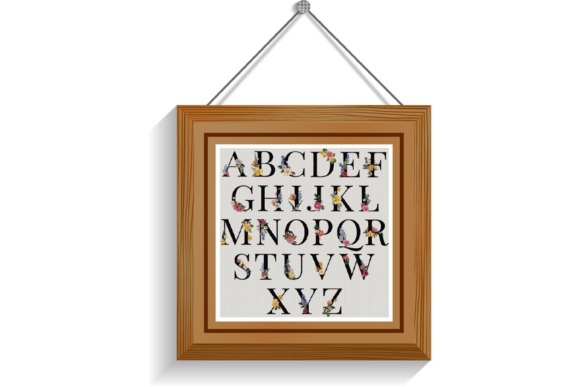
Alphabet Cross-Stitch Chart Patterns: Practical, Print-Ready Design Resources for Serious Stitchers
Alphabet cross-stitch chart patterns represent a focused, high-fidelity resource for stitchers who prioritize precision, consistency, and professional-grade output. Unlike generic or decorative lettering sets, this Alphabet is built around a single, unified grid specification—420 × 440 stitches—and delivers three distinct, purpose-built chart versions in one downloadable package. It’s designed not for casual experimentation but for repeatable execution: whether you’re stitching a custom monogram, branding a textile product, or developing a reproducible design system for client work.
What Makes This Alphabet Distinctive—and Why It Matters
This Alphabet isn’t a collection of isolated letters or stylized fonts. It’s a cohesive, full-alphabet chart set rendered at a fixed, large-scale resolution (420W × 440H), with every character proportionally balanced and uniformly spaced. The design area measures approximately 30 × 31.43 inches when stitched on 14-count Aida—making it ideal for wall art, framed signage, or large-format textile installations. Crucially, it uses full stitches only: no half stitches, fractional stitches, or backstitching. That eliminates ambiguity during execution and ensures clean, consistent results across all 26 letters plus numerals and common punctuation.
The chart relies exclusively on 31 DMC Cotton Floss colors—no substitutions, no approximations. Each color is mapped precisely to its official DMC number and name, and the accompanying floss usage report quantifies skein requirements per color. That level of specificity supports accurate material planning, budgeting, and inventory management—especially valuable for educators prepping classroom kits, small-batch makers fulfilling orders, or freelancers quoting production timelines.
Three Chart Versions—Each Serves a Clear Purpose
Rather than offering a single chart format, this Alphabet provides three optimized variations—each downloadable as a standalone PDF. This isn’t redundancy; it’s intentional flexibility based on real-world stitching conditions:
- Chart 1: Symbols over Colors — Ideal for screen-based reference or digital annotation. Color blocks serve as intuitive visual anchors, while standardized symbols (×, +, ●) differentiate thread types or highlight key structural elements. Best used on tablets or dual-monitor setups where zooming and panning are routine.
- Chart 2: Black Symbols over White Background — The most printer-friendly option. High-contrast black-on-white rendering minimizes ink usage and maximizes legibility—even at reduced print sizes. Recommended for workshops, shared studio environments, or when printing multiple copies for team use.
- Chart 3: Color Blocks Only — A pure visual reference. No symbols, no numbers—just contiguous color fields aligned to the grid. Useful for color-checking physical floss against the design, verifying dye lot consistency, or building a physical swatch board before stitching begins.
A high-resolution color image of the complete design is included—not as a substitute for the charts, but as a fidelity check. You can compare your stitched progress against it without misreading symbol conventions or grayscale interpretations.
Practical Performance: What You’ll Experience When Using It
In actual use, this Alphabet performs consistently across skill levels—but its advantages become most apparent in structured, repeatable workflows. A freelance textile designer recently used it to produce six identical alphabet banners for a boutique retail launch. Because the grid and color mapping were fixed, they stitched one banner as a master sample, documented time-per-section, then scaled labor estimates accurately for the remaining five. No re-charting. No color guesswork. No last-minute substitutions.
Educators report similar efficiency: one university-level fiber arts instructor adopted it for a semester-long typography module. Students worked from the same chart set but chose different versions based on their learning goals—some used Chart 2 to practice symbol decoding; others used Chart 3 to explore color theory through stitch density and hue adjacency. The uniform grid enabled direct comparison of technique, even when final outputs varied stylistically.
That consistency extends to long-term reliability. Because the chart uses only full stitches and avoids blending or shading techniques, it holds up well over time and across fabric types—from standard Aida to linen or even waste canvas transfers. There’s no “fading” of detail due to ambiguous symbols or low-resolution rendering. Every stitch position is unambiguous, every color assignment traceable to an official DMC standard.
Who Benefits Most—and Where It Fits Naturally
This Alphabet serves professionals and advanced hobbyists whose work depends on repeatability, documentation, and clarity—not just aesthetics. Small business owners producing custom embroidered goods will appreciate the floss usage report: it converts creative intent into measurable cost and time variables. Bloggers and content creators documenting cross-stitch techniques benefit from the three-format structure—it allows them to illustrate process variations without needing to generate custom charts for each post.
It’s also well-suited for collaborative projects. Because all three chart versions align pixel-for-pixel to the same underlying grid, team members can work from different formats without misalignment. One person may stitch from the color-block version while another annotates the symbol-over-color chart for tutorial purposes—their outputs remain synchronized by design.
That said, it’s not optimized for rapid prototyping or experimental lettering. If your goal is to sketch rough concepts, test unconventional spacing, or blend fonts mid-project, this Alphabet’s rigidity becomes a constraint—not a feature. Likewise, users working exclusively on very small canvases (<10 inches wide) may find the scale impractical without significant resizing (which risks symbol distortion). Its value emerges where fidelity, scalability, and reproducibility are non-negotiable.
Quality, Usability, and Long-Term Utility
The PDFs are generated at high vector resolution—meaning they scale cleanly to any print size without pixelation. You can output a 4-inch proof or an 8-foot wall chart from the same file, and symbols remain crisp, colors remain distinct, and grid lines stay sharp. There’s no reliance on embedded raster images or low-DPI previews. That technical choice reflects an understanding of how stitchers actually work: some prefer small printed sections taped to a hoop; others project the full chart onto a wall-mounted surface.
Usability extends beyond format. The 31-color palette avoids near-duplicates (e.g., DMC 3799 and 3800 appear together only when meaningfully differentiated in value or hue), reducing visual fatigue during extended stitching sessions. The floss usage report doesn’t just list counts—it groups colors by estimated skein consumption, helping users identify which threads to stock in bulk versus order sparingly.
Long-term, this Alphabet functions less like a one-off pattern and more like a foundational asset. Once integrated into a workflow—whether for branding, teaching, or production—it becomes a stable reference point. Updates aren’t needed for stylistic shifts because the design intentionally avoids trend-dependent flourishes. It’s built to last as long as DMC’s color numbering system remains in use.
A Final Note on Realistic Expectations
This Alphabet delivers exactly what its specifications promise: a large-scale, fully charted, print-ready, floss-quantified, symbol-consistent cross-stitch resource. It does not include embroidery guides, framing suggestions, or alternative font variants. Its strength lies in restraint—not in breadth. If your priority is control, accuracy, and seamless integration into documented processes, it meets that need directly. If you’re seeking expressive variation, historical type studies, or mixed-media adaptations, other resources may better suit your aims. But for those who stitch with intention—and expect the same from their tools—this Alphabet earns its place as a reliable, professional-grade reference.